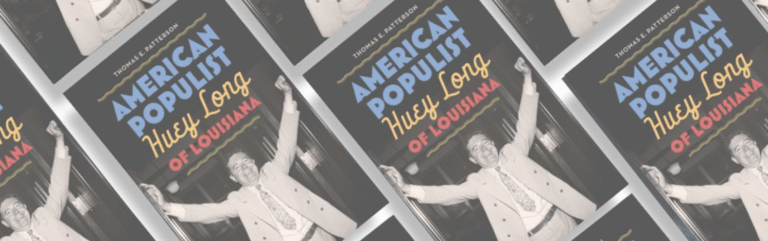
Thomas E. Patterson, a Chicago lawyer, is the author of a new biography of Huey Long published by LSU Press. It’s called “American Populist: Huey Long of Louisiana.” Promotional materials describe it as “a profound reevaluation of his life and legacy, recognizing him as an inspirational progressive thinker, populist hero, and radical influence on the New Deal before an assassin’s bullet ended his life in 1935.” This interview has been edited for clarity.
Q. What prompted you to write the book on Huey Long?
A. I got interested in Huey with the (T. Harry) Williams biography and the Ken Burns documentary, reading “All the King’s Men” and seeing the movie and following the subsequent scholarship after Williams where some people said Williams was too favorable. He (Huey Long) was a fascinating character. If you’re looking at a biography, you want an interesting guy or an interesting woman and interesting times. Huey’s fascinating. He had faults and talents, victories, defeats, comebacks, conflicts, all the things you learn in 8th grade English. Huey v the bank. Huey v. his brother. Huey versus the New Orleans political machine. Huey v the Louisiana oligarchy. Huey v FDR. Then you have interesting times, the age of the plutocrats, the robber barons, WWI, the Roaring 20s, then the Great Depression. With all that going for me, if I wrote a bad book, it’s all my fault.
Q. Why are we still talking about Huey Long today?
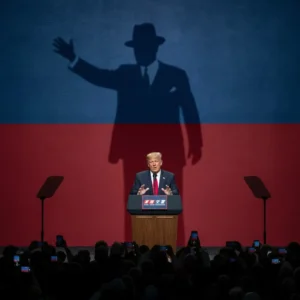
A. Huey’s issues have resurfaced. They were buried for a long time in the aftermath of WWII when wealth and inequality was less of an issue in the 1950s and 1960s. Now it seems to have been resuscitated recently. Huey is relevant today. I think Donald Trump has read quite a bit about Huey Long or someone close to him has. You look at his tactics – “Make America Great Again” versus “Every Man a King.” The lengthy speeches, the demonization of his opponents, the appeals to the people. Huey Long and Donald Trump are opposite sides of the same populist coin. If you want to understand Donald Trump, you’d do well to read my book. If you want to learn how to defeat Donald Trump, you’d do well to read my book.
Q. How are Huey and Trump similar?
A. Trump dominates the news media all the time, every day. He’s mastered the new medium of X or Truth social. Huey mastered the new medium of radio. Huey had unparalleled reach and frequency and unlimited energy to discuss his proposals and his ideas, and he always had a response. He always had a proposal. He always had a program. Donald Trump is very similar in that way, although they seem to be working for opposite goals.
Q. Do you see any connection in the ways that Huey used or abused the media compared to what Trump does today?
A. I see a connection. Huey had unparalleled reach and frequency to the people of Louisiana when he was in power and was beginning to do that nationwide. Trump has the same reach and frequency. They both engaged in harsh denunciations of their opponents. That’s a similarity. That can be extremely disagreeable when the person being attacked doesn’t have the same platform that the politician attacking them has. Both Trump and Huey have done that. Both Trump and Huey understood salesmanship in completely different times. Huey understood right away the power of the radio. He could, by giving radio speeches, avoid the censoring effect of newspapers. He could talk directly to the people through the radio. He would try to get them on his mailing list. That was his big effort. Trump understands social media and the television media through The Apprentice. He’s helped quite a bit by having Fox and those people own about half the media stations in the United States. Trump has grasped that new media in a way that Bernie Sanders and Elizabeth Warren and all the rest of them do not. He has something every day. You can see a connection between Trump’s missteps on Day 2 to bury the missteps on Day 1. So they get buried. Huey made news so often that he could bury his missteps, too, because he was so frequent. He had that blizzard of rumors, proposals, ideas, attacks and so on that dominated the media. Trump has the same thing. He probably gives more interviews than any other president in my lifetime. The Democrats, either because [then-President Joe] Biden couldn’t do it or wouldn’t do it, didn’t grasp the significance of Trump’s actions in his first term. Biden could have dominated the media, assuming he wasn’t decrepit. But he didn’t. Franklin Roosevelt dominated the radio. Kennedy dominated television, and so did Reagan. Now we have Trump, who dominates the new media, and he uses it more frequently.
Q. What do you see as Huey’s legacy today?
A. I’d like his legacy to be his vision both for Louisiana and the United States. Underappreciated is that Huey had an appreciation of greatness solely apart from political power and fame. Williams has this great point that Huey started with the band and the football team to rejuvenate or improve LSU. That’s an instinctive politician’s choice, something people can see, something people can understand, something that would make fans of the school itself. Huey expanded LSU. They recruited terrific professors, like Robert Penn Warren, to LSU. LSU was expanding when all the other colleges and universities in the country were retrenching because of the Depression. Huey was expanding. Huey had a vision of excellence.
Read the original article HERE
