Huey Long displayed a peculiarity in practicing law in the 1920s. In those days, the oral arguments were longer, and a colleague found Huey in the clerk’s office while his opponent was arguing Huey’s case. “You better get in there, Huey, your opponent is arguing your case.” Huey replied, “I never listen to my opponent’s argument; I concentrate on my own presentation.” The application of this story today can only be metaphorical: generally, arguments are relatively short and it would be discourteous to introduce yourself to the Judge and then leave while your opponent argued.
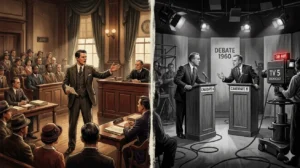
(But I do recall a story about the late Max Wildman, a legendary trial lawyer. Once in a jury trial, Max left at about 3pm while his opposing counsel was questioning a witness. Max left a junior associate behind to represent Max’s client. The opposing counsel was livid, however, asking how dare Max leave before the end of the day. The Judge replied, “If Mr. Wildman doesn’t think your witness is testifying to anything important, he is free to leave.” The jury got Max’s message.)
Something impelled me to watch the Kennedy-Nixon opening debate of 1960, widely considered to have boosted Kennedy’s campaign, and I wondered why. The debate was supposed to cover domestic policy, not foreign policy. At the time, Nixon was known as a fierce anti-communist, and he had debated Russian leader Kruschev in the famous kitchen debate while he was Vice-President.
In a brilliant opening statement, Kennedy framed the issue of the United States versus Communism, stating that unless we improved our economy, Communism would claim world leadership. This stole the anti-communist argument from Nixon during what was supposed to be a debate about domestic policy, thus catching Nixon by surprise. Kennedy’s opening was grounded on his theme that the United States could do better, and that we needed to do better because we were falling behind Communist Russia, then led by Nikita Khrushchev. A few excerpts:
We discuss tonight domestic issues, but I would not want [to imply] that this does not involve directly our struggle with Mr. Khrushchev for survival. Mr. Khruschev . . . maintains the Communist offensive throughout the world because of the productive power of the Soviet Union itself. . .. [T]he kind of society we have, the kind of strength we build in the United States will be the defense of freedom . . .. If we fail, then freedom fails. Therefore, I think the question before the American people is: Are we doing as much as we can do?
[He then provided a litany of ways that the United States was falling behind or could be improved. He closed with this line:]
I think it’s time America started moving again.
What made me think of Huey, however, was Nixon’s response. He had listened to Kennedy’s opening rather than concentrated on his own presentation. In responding to Kennedy, he started with: “The things that Senator Kennedy has said many of us can agree with.” He then admitted that domestic policies have a “tremendous bearing on our international position. There is no question but that this nation cannot stand still. . .. I subscribe completely to the spirit that Senator Kennedy has expressed tonight, the spirit that the United States should move ahead.”
After a few more similar statements, Nixon found a groove, reciting statistics showing that the United States had progressed more during the last eight years of the Republican (Eisenhower-Nixon) administration than it had during the preceding seven plus years of the Democratic (Truman) administration. But it was too late. If he had started with the statistics, that is, what he had planned to say, instead of replying to what Kennedy had said, that is, if he had ignored what Kennedy said, he would have been more persuasive.
After providing these good points, Nixon closed with this craven nod to Kennedy: “Let us understand throughout this campaign that [Kennedy’s] motives and mine are sincere . . .. I know Senator Kennedy feels as deeply about these problems as I do, but our disagreement is not about the goals for America but only about the means to reach those goals.”
Trial lawyers are taught the principles of primacy and recency, the need to open strong and close strong. Here Nixon’s opening and his closing were weak, crediting his opponent’s vision and his sincerity. If Nixon had concentrated on his own presentation, he would have won the debate, and he would have won the presidency in 1960.
