
The comparison of Trump with Huey as to style and tactics is now so overwhelming as to suggest that someone close to Trump has read quite a bit about Huey. Consider these similarities, provided off the top of my head:
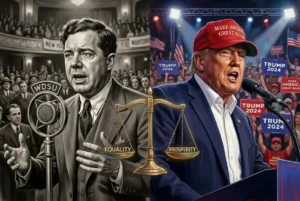
I expect any day now to hear a MAGA song that could compare with Huey’s campaign song, Every Man a King, for that is about the only tactic that Trump has not yet borrowed from Huey.
Their biggest similarity deserves more comment. Trump’s domination of the media was an outgrowth of his experience promoting real estate development projects and his television series, comparable to Huey’s experience as a traveling salesman for four years beginning when he was 16 years old and ending when he started law school. In Huey’s time, radio diminished the power of newspapers, a power that they didn’t recognize was undercut. Many newspapers must have been amazed at how they could pound Huey (and to a similar extent, Roosevelt) without diminishing his popularity. Today, the legacy television outlets compete with cable television and the internet, and they must similarly wonder how they could pound away at Trump without reaching a tipping point that destroyed him. Trump had Fox News, a house organ, to counteract the legacy media, just as Huey had his own house organ, his American Progress newspaper, as well as his numerous circulars, to rebut the big newspapers of his day.
Huey’s opponent Harry Gamble worried that lies were like a pillow’s stuffing knocked out at the top of a skyscraper, so numerous as to be impossible to rebut. Gamble thought that an honest politician would always be at a disadvantage in a democracy because he would argue only truthful allegations against an opponent, whereas the opponent could respond with a blizzard of lies, not all of which could be rebutted.
Trump’s energy and time devoted to outlast critics, with various ideas, proposals, or rumors of contemplated actions keeps himself in the news, his opponents on the defensive, and provides new stories that bury old missteps. Whether they are lies or truthful proposals and arguments, a politician who lacks the energy or the time to respond or set up a competing blizzard of proposals and arguments is at a disadvantage. Trump’s use of this principle established his domination of political discourse.
Trump, like Huey, is erratic on a day-to-day basis, in ways that excite the media but get forgotten by the public. When Trump became President in 2017, his first term, he first agreed to meet with the New York Times, then canceled the meeting, and then had the meeting. I doubt that anyone else remembers that, and I only remember it because I thought at the time that Huey was similarly erratic in these forgettable ways.
A man who built large hotels filled with gold might seem to be one who could restore greatness, just as Huey ensured that he built structures such as the new state capitol or his roads and bridges that impressed even hostile commentators. These provide what advertisers call “reasons to believe” their promises.
Trump’s approach to the presidency is thus a more extreme and modern version of the media-dominant presidencies of Roosevelt, Kennedy, and Reagan. He spends more time on communication (receiving and delivering) than he does studying policy. He sets an unrivaled example for the frequency and reach of his advocacy and has established a new model for how to allocate a president’s time. No Democrat until Gavin Newsom (ten years later) has tried to keep up with him. Biden and other democrats ignored or were incapable of learning and using this lesson before the 2024 election, with fatal results.
In a future blog, I will comment on Trump’s second term and describe significant differences between Trump and Huey.
