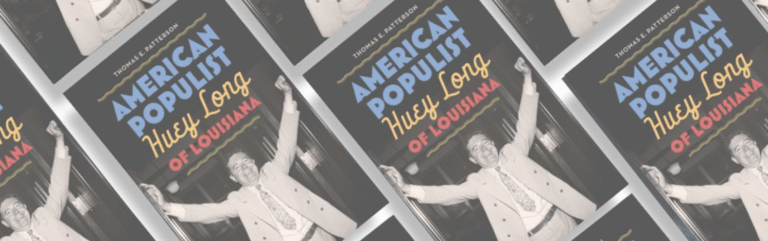
In American Populist: Huey Long of Louisiana, Thomas C. Patterson presents a distinctive and thorough biography that reexamines the life and legacy of Huey Long, offering fresh insight into the roots and repercussions of political polarization. Through a critical analysis of Long’s rise to power, Patterson uncovers the key factors behind his popular appeal, dismantles long-held myths about his tenure, and illuminates the complex forces that precipitated his dramatic fall. In doing so, he prompts readers to reconsider whether today’s deeply divided political climate is a new phenomenon — or part of a much older American tradition.
To uncover Patterson’s writing process as he prepared to write this compelling biography, continue reading the interview I had with him below.
What initially drew you to Huey Long as a subject, and how did that interest evolve as you researched and wrote the book?
Huey was a fascinating politician. He combined salesmanship, legal acumen, and public speaking ability. His political solutions capitalized on grievances, were difficult to attack, and readily achievable. He promised a lot and then delivered a lot.
I read the T. Harry Williams biography and watched the Ken Burns documentary, but later writers disagreed with Williams and had a more negative take on Huey. Then the financial crisis of 2008–09 resurrected wealth inequality as an issue, and that was Huey’s primary concern. With new methods of research available, I thought I could get answers to the questions that had divided or bedeviled historians and which had aroused my curiosity.
What was your research process like for this biography? Were there any
primary sources or archives that particularly shaped your narrative?
I read all the secondary literature that I could find, including published books and unpublished theses. After the Williams biography (and maybe because of it), many writers took slices of subject matters and wrote more in-depth about them, and others considered the larger questions of Huey’s impact on the nation.
I consulted Huey’s personal papers which were discovered after the Williams biography was published; the interview summaries that Williams created of his oral history interviews; and papers of Huey’s contemporaries. I read every article that mentioned Huey in the Chicago Tribune and the New York Times between 1928 and 1935, local Louisiana newspapers to the extent I thought necessary, and the Congressional Record during the time Huey was in the senate.
I studied a lot of literature on the Great Depression. Huey’s papers were revealing on his boyhood and legal career, and after that I plotted his activities on an almost daily basis, establishing cause and effect relationships, noting differences between, for example, the Congressional Record and what the newspapers said or omitted, and between other writers and the primary sources.
How did you balance objectivity with storytelling when writing about such a polarizing figure?
Lawyers must be story tellers, but before they write the story, they must be skeptical of everything. So I was skeptical of other writers, the newspapers, and what people said in their oral history interviews. I probably have one or more disagreements with every writer that has considered Huey, despite respecting and benefitting from their work. Many times I let the facts speak for themselves. Some things can’t be known. I tried to leave space in the narrative for people to consider the issues and draw their own conclusions.
Was there a specific moment during your writing when the direction or tone of the book shifted unexpectedly?
There were several. First, I realized how often Huey was ridiculed or reprimanded. I was able to collect many of those examples in one chapter without doing violence to the narrative. Second, when I became aware of social movement and recent revolution literature and realized that in many ways their theories explained elements of Huey’s success. Third, when I compared Governor John Parker with Huey, including their attitudes about Louisiana State University, as reflected in some of the writings of Robert
Heilman and others. Fourth, when I digested the literature about the Great Depression and compared the responses of Huey and Roosevelt. Finally, when I analyzed the economics of the Share Our Wealth plan that Huey proposed.
How long did the project take from conception to publication, and were there any major challenges along the way — logistical, emotional, or otherwise?
I started thinking about the project near the time of the financial crisis of 2008–09, and after seeing books by Piketty and Stiglitz discussing the problems with wealth inequality. The first draft of chapter one was written around September 2014. The challenges were my day job, my desire to travel to other cities to visit libraries with collections of papers I wanted to read, and my wife’s desire to have our condominium free from the clutter of books, drafts, newspaper articles, and notes. Many months I worked on it for 1.5 hours in the morning before work, 2.5 hours after work, 8 hours on Saturday, and 6 hours on Sunday. Luckily, I was able to combine travel for work or vacations with research trips.
The final challenge was to cut 180,000 words from the manuscript as requested by the publisher. It took me more than five rounds of review; I kept a chart of how many words I had cut from each chapter per round, until I got it down to 250,000 words. It’s a little denser now, but the cuts also eliminated some redundancies that had crept in, and I was
happy to get rid of them.
Did your personal feelings about Huey Long change over the course of writing the book? If so, in what ways?
I knew from Williams’s book that Huey had talent and flaws, but I hadn’t realized the extent to which ideology drove his actions and how hard he worked to recover from some reverses (some of which he inflicted on himself). His willingness to defy the rest of the senate made an impact on me. More surprisingly, perhaps, my feelings about other progressives changed. Progressives I had admired from a distance lacked an overriding
philosophy of change, an ability to mobilize in a practical way, and a willingness to challenge Roosevelt.
My feelings about Roosevelt have changed, too. I had originally accepted the conventional wisdom that Huey was too ambitious to cooperate with Roosevelt, but the bigger reason for their split was that Roosevelt wanted personal loyalty at the expense of principles or that he was insecure about Huey’s superior intellect or forceful personality. Lincoln worked with rivals; Roosevelt didn’t. Roosevelt wasn’t the great progressive that people often credit him with being. He was a cautious, middle of the road politician who was open to new ideas, which seemed progressive in comparison with the staid presidents who preceded him.
Was there a particular discovery or event in Huey Long’s life that impacted you emotionally or changed how you viewed him?
I had always accepted the conventional wisdom that he was a genius. That creates a certain distance between him and the rest of us ordinary mortals. But to my surprise he really studied. The amount of reading he did has been under-appreciated, as has his personal growth. Regarding his speaking ability, the conventional wisdom is that he was a demagogic spellbinder. But his idea that wealth inequality was bad was shared and
articulated by preceding politicians Theodore Roosevelt and Woodrow Wilson, for example, and thus he built on an existing idea. The number of speeches he gave over the course of several years in many campaigns undoubtedly honed his speaking ability.
That he studied books, the law, and the ideas of others and that he practiced his speechmaking makes him more accessible, and it also means that the elements of his success can be considered by ordinary mortals and adopted to the extent one deems appropriate.
As a biographer, how do you cope with spending so much time immersed in the life of someone as complex and controversial as Long?
Huey’s story was fun to write. He lived an intense, exuberant life, and he accomplished a lot. Figuring out how he did it along with certain mistakes he made was rewarding. One of his sisters said that of the nine children, Huey was the most fun and the most serious.
In a speech I gave, I said that my biography was not a self-help book, but that if I had read the book I just wrote 40 years ago, I would have had a more successful career. You can learn from him whether or not you are a politician.
Were there moments when you felt conflicted — admiring his vision while being unsettled by his tactics? How did you navigate those emotions in your writing?
Whether the ends justify the means is a question that arises often in the book. Most of the time, I just set forth the facts. I don’t think the demagogue charge is fair; it seems to be an epithet used against anyone who challenges the status quo; but I didn’t like his denunciations of people who lacked a comparable platform to respond. There is space for the reader to consider these and other issues and him and decide for themselves how they feel about the issues he raised and about his actions personally.
What do you hope readers feel after finishing the book — not just intellectually, but emotionally?
I hope they feel satisfied that I have written the most comprehensive, balanced, and analytical biography about a very fascinating politician. One of the publisher’s anonymous reviewers said:
Going in, my internal dialogue went something like: Does the world really need another Huey Long biography? No, of course not; we already have Williams and Hair, plus all the others.
But as I read, I found myself saying: That’s interesting.
I’ve never thought of this in that way. More importantly, neither did Williams or Hair or all the others. So clearly the author has much to say that is new. And this goes beyond Huey Long. If the interpretation of the Kingfish is revised, so, too, is the interpretation of Long’s opponents and supporters. Franklin Roosevelt and Joseph Robinson come out looking very differently than one might expect…
As this interview suggests, Patterson has earned considerable praise for his meticulous research and balanced portrayal of Huey Long, offering readers a nuanced lens through which to reflect on Long’s complex legacy. His writing process was a labor of love that contributed to a fascinating read about Long that inspires discourse in political theory.
Read the original article HERE
