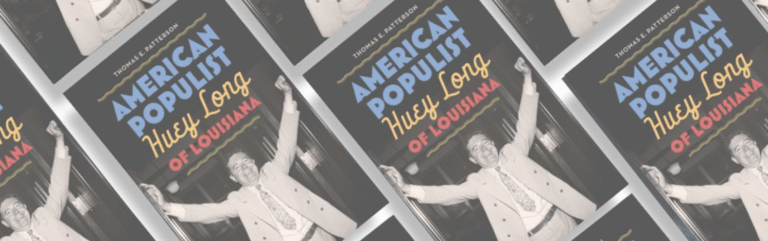
An informative article in New Republic magazine by Dylan Gyauch-Lewis (July 23, 2025) discussed the theory of abundance, now advocated by Ezra Klein and Derek Thompson. The article traces this idea back to the 1930s and lumps Huey Long in with other progressives such as Robert and Philip LaFollette, Fiorello LaGuardia, Floyd Olson, Gerald Nye, and Father Charles Coughlin.
The New Republic accurately noted that Roosevelt was unpopular with many on the left; he was considered centrist and middle-of-the road. His popularity among leftists ebbed and flowed. In 1933, Progressives were keenly disappointed in Roosevelt’s appointment of William Woodin as Treasury Secretary, his weak Banking Act, and his inhumane cuts to veterans’ benefits. Huey and other progressives were responsible for adding to the Banking Act provisions for the insurance of bank deposits and aid to state banks, measures Woodin opposed and to which Roosevelt acceded only reluctantly. LaFollette wrote in early April 1933 that Roosevelt thought his bank bill and employing people on the Civilian Conservation Corps are all that is needed to restore prosperity; “to my mind this is pure bunk”.
Roosevelt recovered his standing with many progressives when in May 1933 he proposed the National Industrial Recovery Act to be administered by the National Recovery Administration (NRA). But progressives were divided by the Bill because it promised industrial planning. Progressive senators LaFollette, Couzens, Wheeler, Norris, and others supported the bill, whose sponsor, Robert Wagner, said that this was a first step toward a nationally planned economy. Other progressive senators—mostly from the south and west—opposed the bill as a sell out to big business, which would control prices and production. The critics such as Huey who had predicted that big business would control Roosevelt’s agricultural program and the NRA were proved right.
The abundance theory in part was a reaction to the NRA and Roosevelt’s Agricultural Adjustment Act (AAA) policies of restricting production. Reducing crops and industrial output while people were starving struck observers as “insane and obscene”. Huey’s critic Arthur Brisbane of the Hearst papers wrote in April 1935 that he now agreed with Huey that production should be increased to match consumption rather than restricted to raise prices.
But there was no consensus among leftists about the solution to the distress caused by the Great Depression. Production for use contemplated government control over production and pricing. Separately, David Cushman Coyle and Huey, in contrast, advocated higher taxes on the wealthy, massive public works, and plans to get more purchasing power to consumers but without precise rules related to production or pricing. Huey proposed to limit the size of fortunes and incomes, give each deserving family a homestead and minimum income, allow free college or vocational education to qualified persons, shorten the hours of work, and provide retirement and veteran benefits.
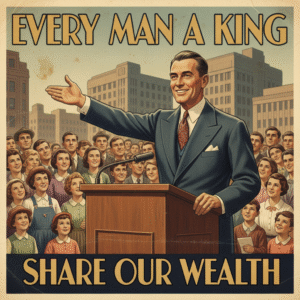
Huey had signed up an estimated 7.5 million people as members of his Share Our Wealth societies by April 1935. Roosevelt feared that Huey could take enough votes from him to tip some key states to the Republicans. At the April farmers’ conference in Des Moines that month, Huey received a resounding reception and the farmers voted to form a third party.
The organizing activities of other leftists were pitiful. LaFollette’s Progressive newspaper cheered one organizing conference when privately an attending senator viewed the conferees as a bunch of crackpots. While progressives conferenced, Huey was on the radio and signing people up.
Progressives agreed that the rich should pay more taxes, that public works should be expanded, that credit should be made easier, that a bonus for veterans should be paid, and that the economy was not working for the average voter. Even after Roosevelt, responding to Huey’s organized pressure, turned to the left and proposed to increase taxes on the wealthy, pass social security, and increase aid to college students, all done to “steal Huey’s thunder,” progressives were still skeptical, but they could not agree on whether a planned economy, a government-controlled economy, or a redistributive taxation policy was the answer.
Huey’s plan would have required deficit spending to provide the benefits he promised, but the experience with World War II spending proves that they could have been provided, and that there would have been a redistribution of wealth, with the previously unemployed or underemployed allocated the greatest share of the increase in the money supply.
The World War II spending jump started the economy, and it reduced inequality. In the 1950s, John Kenneth Galbraith wrote that liberals and conservatives reached a truce about redistributive taxation; both thereafter concentrated on increasing productivity. Against the backdrop of the more equal wealth distribution in the 1950s, this seems reasonable. But before the redistributive effects of the war- spending were felt, the Great Depression students of wealth distribution believed that reducing inequality would grow the economy. Redistributive taxation and abundance are not mutually exclusive concepts. Allocating more money to the bottom 99% of the people will provide the consumption power necessary to induce investment and productivity improvements. Redistributive taxation will grow the economy and provide abundance.
